“The Mystery of Oak Island”
“The Mystery of Oak Island”
“The Mystery of Oak Island”
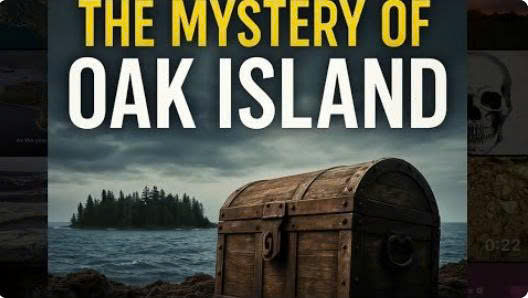
Just off the coast of Nova Scotia
lies a small patch of land called Oak Island.
A quiet, windswept place
that has fueled obsession for more than 200 years.
To the casual eye,
it’s nothing but forest and rock.
Yet beneath its soil,
generations of treasure hunters have believed
something extraordinary is buried.
The legend began in 1795
when a teenager named Daniel McGinnis
noticed a strange depression in the ground.




Nearby,
an old oak tree hung over it —
a thick branch scarred by the marks of a pulley or rope.
Daniel was convinced
it was the site of a hidden cache —
maybe pirate gold.
He returned with two friends
and started digging.
Ten feet down,
they struck a layer of wooden planks.
They dug through.
Then another layer at twenty feet.
And another at thirty.
Each sealed tight
with clay and logs,
as if someone had built a trap
to protect whatever lay below.
The deeper they went,
the more impossible it became to stop.
When they reached ninety feet,
their shovels hit a final barrier —
a flat stone carved with strange symbols
no one could read.
That night,
the pit began to fill with water —
rising fast,
as though the island itself
were defending its secret.
The boys fled,
believing they’d uncovered a curse.
From that moment on,
the hunt for the Oak Island treasure
would claim fortunes,
lives,
and sanity.
Over the next century,
dozens of teams tried and failed.
They built dams,
pumped out water,
drilled shafts,
even used dynamite —
but every attempt ended in collapse or flooding.
In one tragic accident,
five men died.
Locals began to call it The Money Pit
and whispered
that it was cursed by those who built it.
“What was buried there?”
Some said Captain Kidd’s stolen gold.
Others believed it held
the lost manuscripts of Shakespeare,
the Holy Grail,
or even the Ark of the Covenant.
Every explorer came with hope
and left with ruin.
As technology advanced,
so did the obsession.
Metal detectors, sonar, drilling rigs —
each promising answers,
each finding only fragments —
bits of chain,
parchment,
a tiny scrap of gold.
But no treasure.
Only the endless whisper of the island itself.
Keep digging.
And so, Oak Island remains
a riddle carved into the earth —
a place where greed, courage, and mystery intertwine,
waiting for the next soul brave enough
to dig into its secrets.
As the years passed,
Oak Island transformed
from a quiet patch of earth
into one of history’s most expensive obsessions.
By the mid-1800s,
engineers, miners, and fortune seekers
from around the world had descended on the island,
determined to break its curse.
Every attempt ended the same way —
flooding.
No matter how deep they dug,
the water came.
It wasn’t natural.
It was a design.
When crews explored the beaches,
they made a shocking discovery —
five artificial flood tunnels
carved directly from the shoreline into the Money Pit,
packed with layers of coconut fiber and stone.
Someone, centuries earlier,
had built an elaborate booby-trap system
that used the ocean itself as protection.
Anytime diggers reached a certain depth,
seawater would rush in through the tunnels,
drowning their progress.
Who could have constructed something that complex
so long ago?
The engineering alone
seemed impossible
for pirates or peasants.
The mystery deepened.
Then came the Truro Company expedition of 1849.
They drilled a narrow shaft beside the pit
and recovered bits of gold chain
and fragments of parchment —
proof that something human and valuable lay below.
Excitement exploded across Nova Scotia.
Investors poured in money.
Newspapers declared
the treasure of Oak Island was within reach.
But as they drilled deeper,
the ground gave way.
Shafts collapsed,
flooding faster than pumps could handle.
Men nearly drowned.
The island seemed alive —
defending its secret.
Over the next hundred years,
the search became a generational obsession.
In the 1930s,
an American named Gilbert Heden returned
with industrial equipment and fresh resolve.
He found strange stone markers
arranged in geometric patterns —
possibly a hidden map leading to the pit.
Others discovered tunnels that crossed and twisted
beneath the surface
like veins in a living thing.
Theories multiplied.
Some claimed Freemasons had buried sacred relics,
guarded by coded symbols and traps.
Others swore it was the final resting place
of Captain Kidd’s gold —
or even the lost treasure of the Knights Templar,
smuggled across the Atlantic
to protect it from persecution.
Yet despite the machinery, money, and manpower,
no one broke through.
Every time a team believed they were close,
the island retaliated —
shafts collapsing,
pumps breaking,
storms rolling in out of nowhere.
Five men were killed
across different expeditions.
A legend formed —
no one would find the treasure
until seven had died.
Still,
the promise of fortune was irresistible.
With each new discovery —
an ancient coin,
a carved stone,
a mysterious link of chain —
hope returned.
Oak Island was no longer just a dig site.
It had become a living myth —
whispering to those who believed
they could outsmart the past.
By the 1960s,
Oak Island’s legend had outgrown Nova Scotia.
It was now one of the world’s greatest unsolved mysteries —
a riddle of gold, death, and obsession.
New technology brought new hope.
Helicopters, pumps, and heavy machinery
replaced shovels and ropes.
But the island’s defenses
were as merciless as ever.
In 1965,
treasure hunter Robert Restall and his son
descended into one of the shafts near the Money Pit.
Without warning,
a pocket of gas leaked upward.
Within minutes,
they were overcome by fumes.
When rescuers rushed in,
they too collapsed.
By the end of that day,
four men were dead.
The curse had claimed more lives —
bringing the total to six.
Locals began to whisper:
“Only one more must die
before the treasure is revealed.”
For a time,
the island grew quiet again.
But the mystery refused to fade.
In the late 20th century,
television and archaeology revived global interest.
Satellite images revealed patterns in the soil —
too precise to be natural.
Geometric alignments, buried tunnels,
and possible chambers
hundreds of feet below the surface.
Then came two brothers from Michigan —
Rick and Marty Lagina.
As boys,
they’d read about the Money Pit in a magazine
and swore one day they’d solve it.
Decades later,
they bought a controlling interest in the island
and began one of the most extensive searches ever recorded.
Their journey became the hit television series
The Curse of Oak Island,
captivating millions worldwide.
The Laginas brought in geologists, historians,
and metal detection experts.
What they found
reignited everything.
Traces of gold and silver
deep within the flood system.
Old wood beams dated to the 1600s.
Coins, iron crosses,
and tools from far before the island was settled.
And perhaps most intriguing —
a lead cross believed to be of Templar origin,
buried far below the surface.
Each discovery hinted
that something immense had once been here —
and that its builders had gone to impossible lengths to hide it.
Some experts believe Oak Island
was a repository for sacred relics —
the Holy Grail,
the Ark of the Covenant,
or manuscripts of ancient knowledge.
Others still cling to the pirate treasure theory,
pointing to coded symbols
and early maps
that trace back to Captain Kidd’s voyages.
Whatever the truth,
the island continues to fight back.
Flood tunnels still collapse.
Caves flood in minutes.
Every time they drill,
the ground seems to move —
as if the treasure itself refuses to be found.
But Rick and Marty won’t stop.
To them,
the island isn’t just about gold —
it’s about solving one of the oldest mysteries on Earth.
A mystery that has waited centuries
for someone brave enough to confront it.
More than two centuries have passed
since Daniel McGinnis first struck his shovel
into the soil of Oak Island.
Generations have come and gone.
Kings have fallen.
Nations have changed.
Yet this small patch of land
still guards its secret.
The world has watched
as machines dig deeper,
technology advances,
and new clues emerge.
But the heart of the mystery
remains untouched.
In recent years,
scientists working with the Lagina brothers
have made discoveries that reignited hope.
Deep scans of the ground
revealed what looks like a vast network of tunnels —
carefully engineered
with precision beyond their time.
At the center lies a massive void —
a hidden chamber
buried more than 150 feet below.
Instruments detect traces of precious metals —
hints of gold and silver,
and artifacts from the 15th and 16th centuries.
Yet even now,
no one has broken through.
The deeper they dig,
the more dangerous the island becomes.
Shafts collapse without warning.
Pumps fail.
Water surges from unseen tunnels —
as though the ocean itself
rises to protect whatever sleeps beneath.
Many believe the island is cursed.
Others say it’s sacred.
Some call it the world’s greatest puzzle.
But for every skeptic,
there’s another believer
who swears the treasure exists —
that something of unimaginable importance
lies beneath the roots and rock.
The truth may not be gold at all.
It could be knowledge —
a secret meant to be hidden
until humanity was ready.
A message carved in earth and time,
waiting for the right hands to uncover it.
Rick Lagina once said,
“There’s a story here that deserves to be told,
even if we never find the treasure.”
And perhaps that’s the real meaning of Oak Island.
It isn’t about the chest of coins
or the glitter of jewels.
It’s about human curiosity —
that unshakable drive to understand what came before us,
and the belief that somewhere beneath the surface,
answers still exist.
At night,
when the wind moves through the trees,
the island feels alive.
The ocean murmurs against the rocks,
and for a moment,
it’s easy to imagine
the voices of those who dug before —
the ones who dreamed of glory
and vanished into the depths.
Maybe the treasure will never be found.
Maybe it was never gold at all.
But the legend of Oak Island endures —
a reminder
that some mysteries aren’t meant to be solved,
only remembered.
And so the island waits —
silent,
patient,
eternal —
guarding its secret
for yet another generation to chase.