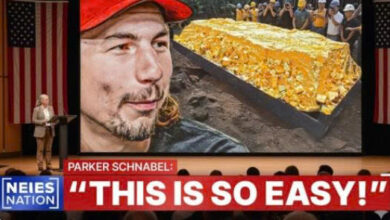
Why Gold Rush Fell Off
Why Gold Rush Fell Off

I think it’s definitely going to come down to the wire for sure.
Right.
This is Gold Rush.
Back in 2010, six broke guys from Oregon decided to fix the recession the only logical way they knew how — by becoming gold miners in Alaska, with no experience, on camera.




That was awesome. You were deep, man. Minute. I’m just going to drive up there.
Their first haul — 14.6 ounces — roughly the value of a mid-range gaming PC.
But it didn’t matter.
Because Gold Rush wasn’t about success.
It was about trying, failing, screaming at machinery — and maybe, just maybe — striking it rich.
And America ate it up.
For a while, Gold Rush was the scrappy underdog story we didn’t know we needed.
It had family drama.
Broken dreams.
Literal explosions.
And the occasional bear fatality.
It was gritty, chaotic, and weirdly sincere.
But something changed.
The gold got easier.
The drama got faker.
The underdogs became millionaires — with production crews and branded merch.
And suddenly, we weren’t watching amateurs chase a dream.
We were watching professionals chase a storyline.
Because Gold Rush used to be about digging for gold.
Now, it’s mining for ratings.
To understand Gold Rush, you need to understand 2010.
The economy was tanking.
Unemployment was sky-high.
And middle-aged men everywhere were rediscovering that one time they panned for gold on a Boy Scout trip.
It was the perfect storm of desperation and delusion.
Enter Todd Hoffman — a former airport owner with a beard that looked like it had survived a separate recession.
I’m going to lose my business. What in the hell happened?
I can tell you what the hell happened, Todd.
Todd gathered a group of equally unqualified friends — all broke, all jobless — and convinced them to spend their life savings on mining equipment.
His pitch? “Let’s go dig in Alaska and film it.”
What could possibly go wrong?
Turns out — everything.
Season 1 was a disaster in the best possible way.
The crew had no idea what they were doing.
Their wash plant broke every week.
They couldn’t operate heavy machinery.
And when a black bear wandered into camp — they shot it off camera, because of course they did.
They ended the season with less than 15 ounces of gold.
Basically, the mining equivalent of finding pocket change in your couch cushions.
And yet, the audience loved it.
Why?
Because this was 100% pure recession porn.
Real people.
Real struggle.
Real failure.
Finally — a reality show without spray tans, Lamborghinis, or producers pretending to care about “the journey.”
Shake. Parker is sitting on top of the world. He has visions.
Gold Rush felt raw — almost too raw.
And the network saw gold.
Figuratively, at first.
By Season 2, the show was officially rebranded from Gold Rush: Alaska to simply Gold Rush.
The operation moved to the legendary Klondike in Yukon.
And young Parker Schnabel — an actual teenage miner — entered the scene with more competence at 17 than Todd had at 40.
From there, the show struck a vein.
By Season 3, viewership exploded.
Parker was thriving.
Tony Beets was introduced — with a voice like gravel in a blender.
I want to make sure we get as much rocks through the drama as we can.
And Todd… well, Todd still had hope.
America kept watching because Gold Rush was no longer just a doc series about mining.
It was a weekly muddy morality play — where every broken machine and failed goal was a metaphor for the American struggle.
Except with way more yelling.
You can only watch a man scream at a bulldozer so many times before you start to wonder —
Wait, didn’t he scream at this same bulldozer last season?
That’s when the first cracks in Gold Rush began to show.
Not in the wash plants — those were always broken — but in the illusion.
What started as a show about ordinary men taking an extraordinary risk
slowly morphed into a reality soap — complete with conveniently timed arguments,
recurring plot lines, and enough heavy-handed foreshadowing to make a Marvel movie blush.
But the real tipping point — the moment Gold Rush truly jumped the shark,
or more accurately, set the shark on fire — was the Viking baptism.
Let’s set the scene.
It’s 2014.
Tony Beets — the gravel-voiced Canadian prospector with a wardrobe of 90% overalls and 10% Viking cosplay —
decides it’s a good idea to pour gasoline into a mining pond and light it on fire.
Why?
Quote Tony — “For fun.”
Because nothing screams responsible mining like creating a flaming pond in protected Canadian wilderness while a camera crew cheers you on.
Bring it across. I saw it was busy, so I decided to park it over here.
I don’t know. This must have went ahead.
The footage aired in 2015.
By 2017, Tony was in court.
Fines were handed out.
Environmentalists were furious.
And Discovery learned a valuable lesson —
arson makes great TV, but terrible PR.
That wasn’t the only explosion.
In Colorado, Todd Hoffman and crew relocated to a town called Fair Play —
which quickly became the most ironically named place in America.
Locals were not thrilled about their peaceful mountain hamlet
turning into an industrial hellscape of 7 a.m. truck noise, diesel fumes, and on-camera drama.
Nice to meet you.
You got some good ground here.
Land is very good. There’s gold in the ground. You just got to get it out.
Huh.
Things got so heated that in 2017, a man literally fired warning shots at the crew to get them off his land.
He was arrested.
The show branded him a rogue gunman.
The town called it self-defense against reality TV.
An activist group called Save South Park sued the county for rezoning land to allow Gold Rush to film.
Even the U.S. Forest Service stepped in and said,
“Guys, you can’t just dig holes on federal land for funsies.”
Who knew?
And then there were the bears.
Oh, the bears.
In Season 1, the Hoffmans shot a black bear that wandered into camp —
an incident quietly swept under the rug until Alaska’s Department of Natural Resources issued a public reprimand.
That bear is not going to get in between my son and I. That I guarantee you.
But that was just the beginning.
Fast forward to 2016 —
Derek Dodge’s team in Yukon killed four more black bears in a single summer.
That’s not mining. That’s a wildlife culling.
Worse — they didn’t report it properly.
Derek eventually settled in court, admitting guilt and paying a fine.
By now, Gold Rush had become a strange hybrid of survival TV, environmental horror, and backwoods courtroom drama.
And then came the fighting.
Not metaphorical — literal.
In Season 1, crew members Jimmy Dorsey and Greg Remberg got into a fistfight so intense it left Dorsey with broken ribs.
Hey, come on.
The others, in a display of adult professionalism, responded by burning his cabin down.
You know — as one does.
Dorsey later revealed that the entire fight was orchestrated by producers.
According to him, much of Gold Rush was scripted from day one.
His exit staged.
The drama encouraged.
The line between reality and narrative — nonexistent.
And once the spell breaks — once viewers realize they’re watching Deadliest Catch with a gold filter and a plot —
the magic is gone.
Meanwhile, Parker Schnabel was mining thousands of ounces per season.
Tony Beets was restoring century-old dredges like it was Antiques Roadshow: Yukon Edition.
And Todd Hoffman — still chasing that one big win.
In Season 8, Parker and Todd made a bet —
whoever mined the most gold would win 100 ounces from the other.
It was hyped like a heavyweight boxing match.
In reality, it was like watching a Formula 1 car race a tricycle.
Parker ended the season with over 6,200 ounces.
Todd — just over 1,600.
Todd left the show shortly after, saying the pressure wasn’t worth it anymore.
Translation: he got stomped so hard the producers couldn’t edit around it.
And yet — the show kept going.
But now, the reality part was on life support.
Every season had the same beats.
Broken equipment.
Ticking clock.
Interpersonal meltdown.
Last-minute success.
Lather, rinse, repeat.
The formula was set.
The stakes — manufactured.
And the audience — slowly waking up.
Tony’s first target on the hill, an 8-acre cut he discovered 30 years ago, filled with big gold nuggets.
Meanwhile, Reddit threads popped up with titles like Proof Gold Rush Is Fake and Is That Even Real Gold?
YouTube exploded with conspiracy videos claiming Discovery staged the cleanouts, borrowed gold for camera shots, or planted drama in post.
And maybe the worst offense of all — it got boring.
Because once the Hoffmans were gone and the underdog struggle replaced by efficient gold-mining industrialists —
Gold Rush stopped being about Can they do it? and became How much more can Parker win?
Turns out the answer is a lot.
But also — who cares?
What was once blue-collar mythmaking had become a corporate content machine.
All gears, no soul.
The show tried to inject new blood, new crews, new locations.
They even sent Parker to Papua New Guinea to pan for gold in crocodile-infested rivers —
a desperate attempt to reclaim the sense of adventure.
Parker and the film crew must wait for the dispute to be resolved.
But by then — viewers weren’t tuning in for grit.
They were watching to see if the show could pretend it still had it.
And spoiler alert — it didn’t.
By the time Gold Rush hit Season 10, the chaos didn’t feel like chaos anymore.
It felt like déjà vu.
Every year — a fresh crew rolled in with big dreams.
Every year — the machinery collapsed on day one.
And every year — Parker walked away with the gold like clockwork.
The whole thing stopped being a gamble.
It turned into a rerun.
And to make it worse — the show doesn’t even look raw anymore.
It’s been polished to the point of parody.
Drone shots sweeping over muddy hills.
Interviews lit like prestige dramas.
Slow-motion dozer footage set to the kind of stock guitar riffs you’d find in a free YouTube library.
What used to be documentary grit now looks like a music video no one asked for.
But the real problem isn’t how it looks — it’s what’s missing.
Stakes.
His shaker deck lies in pieces.
And Sluice has run out of room for tailings.
Parker brings in millions every season.
Tony Beets plays Yukon mogul with his fleet of dredges.
These aren’t desperate dreamers anymore.
They’re industrialists pretending to struggle for the cameras.
Watching them is like watching Elon Musk apply for a payday loan.
Discovery’s solution?
Spin-offs.
More shows.
More crews.
More noise.
Parker’s Trail.
Whitewater.
Freddy Dodge’s Mine Rescue.
Hoffman Family Gold.
They’ve turned one dead horse into an entire franchise stable.
And the audience — they’ve caught on.
Reddit threads rip apart the recycled drama.
YouTube channels accuse producers of staging every cleanout.
TikTok mocks the show’s clichés with parody gold-panning dances.
Gold Rush isn’t blue-collar ambition anymore.
It’s the McDonald’s of reality TV — predictable, polished, pointless.
So yes, the show is still digging —
but mostly, it’s digging its own grave.
To be on track for Tony’s 5,000-ounce season goal, cousin Mike needs to deliver 200 ounces.
Gold Rush wasn’t supposed to become this.
It started as a scrappy, recession-era underdog story —
real men with real problems, risking it all on a dream that smelled like diesel and desperation.
For a moment — it was magic.
A muddy middle finger to Wall Street.
Blue-collar ambition with just enough chaos to keep you hooked.
But somewhere along the line, the dream got syndicated.
The crews got richer.
The stories got cleaner.
The stakes got safer.
And what once felt like a raw slice of reality
is now just another polished product — with commercial breaks and drone shots.
And maybe that was inevitable.
After all — how long can a show about failing miners survive once the miners stop failing?
The truth is, Gold Rush worked best when it didn’t work.
When broken machines and broken dreams felt more real than the gold.
When yelling at a stuck loader wasn’t a plot beat — it was panic.
When you believed, just for a second, that maybe this year, they’d finally strike it big.
Now — we watch millionaires pretend to struggle.
And the only thing being mined anymore… is nostalgia.
So, can Gold Rush be saved?
Sure — if they somehow reverse time, lower gold prices, fire half the camera crew, and make Parker broke again.
But until then —
we’re just watching men in reflective vests act surprised that Yukon gets cold in October.
Because in the end — Gold Rush was never really about gold.
It was about hope.
And once you lose that —
all you’ve got left is noise, mud,
and Tony Beets lighting things on fire.
So hey — like, subscribe, and comment below:
Which reality show should end its final season in a dredge pond?