BEYOND THE SURFACE: Shocking Lot 5 Discovery Challenges Long-Held Theories on Oak Island
BEYOND THE SURFACE: Lot 5 Discovery Challenges Long-Held Theories on Oak Island
Oak Island, Nova Scotia — For more than two centuries, treasure hunters have focused almost exclusively on the legendary Money Pit and its intricate flood tunnels. But in Season 13 of The Curse of Oak Island, a series of remarkable finds on Lot 5 is forcing the Lagina brothers and their team to rethink everything they thought they knew about the island’s history.
Located near the shoreline on the southwestern side of the island, Lot 5 has emerged as one of the most intriguing excavation sites this season. What was once considered a peripheral area is now revealing clear evidence of sustained human activity that predates the 1795 discovery of the Money Pit by decades — and possibly by centuries.
 \
\
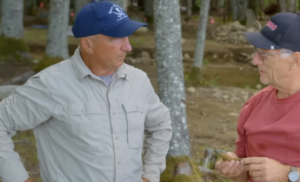
In early episodes of Season 13, the team uncovered a massive stone foundation near the shoreline. Archaeologist Laird Niven and the crew noted the deliberate construction, including carefully placed angular rocks that do not appear to be the result of simple farmland clearing. The feature includes both circular and rectangular man-made structures, suggesting it may have served as a staging area, living quarters, or support base for whoever operated on the island long ago.
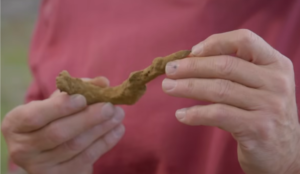
One of the most compelling discoveries came in Episode 20, “The Sands of Time”, when Marty Lagina and Gary Drayton investigated a mysterious stone well on Lot 5. The covered well indicates that people once lived or worked on the lot for extended periods, as a reliable water source would have been essential. Metal detecting around the well also yielded an iron hook, likely used for lowering buckets or lanterns — further evidence of daily human activity.
Additional finds on Lot 5 include 18th-century British artifacts that predate the original Money Pit discovery by at least 50 years. Some clues even point to possible European presence as early as the 13th century, adding fuel to long-debated theories involving the Knights Templar or other pre-colonial visitors.
These discoveries are challenging the traditional narrative that all significant activity on Oak Island was concentrated solely around the Money Pit. Instead, Lot 5 suggests the island may have hosted a broader operation — possibly a base camp, safehouse, or logistical hub — with multiple structures built deliberately across different lots.
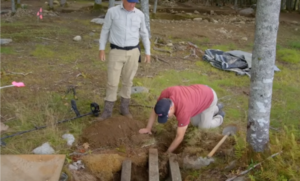
Rick and Marty Lagina, along with experts like metallurgist Emma Culligan, continue to analyze samples and artifacts with scientific precision. The team is now exploring potential connections between the Lot 5 structures, the swamp’s ancient man-made features, and the ongoing work on Lot 8.
While no major treasure has yet been recovered, the findings on Lot 5 are shifting the focus from a single “pit” to an entire island-wide mystery. As one team member noted, the discoveries are peeling back layers that have been hidden “beyond the surface” for hundreds of years.
As Season 13 progresses, viewers and researchers alike are watching closely. Could Lot 5 hold the key to understanding who really visited Oak Island centuries ago — and why? The island continues to rewrite its own story, one careful excavation at a time.