Alan Tudyk Interview | Resident Alien Season 4 | SDCC 2025
Alan Tudyk Interview | Resident Alien Season 4 | SDCC 2025
Alan Tudyk Interview | Resident Alien Season 4 | SDCC 2025
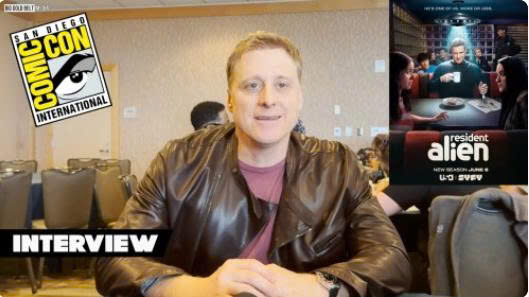
How you doing today?
Uhhuh.
It’s a—it’s a purse that you can buy from Disney.
I’m not selling it.
I was—I was gifted this.
Uh, somebody was suggesting maybe it’s what you put your Juilliard diploma on.
Can you have one of those?
Uh, now I—I was gifted this just over there.
But Juilliard—oh, Juilliard.
Well, I sort of left my third year, but let’s—let you know.
I had other things to do.
It worked out.
Yeah. Yeah.
Things are going well.




Yeah. You’ve been on the stage here at Comic-Con so many times.
Obviously, on a sad note today, kind of close it out—
but what was the journey like announcing that you’re ending?
What was great was we announced in at New York Comic-Con,
but today when we were, you know, finishing Resident Alien,
the stage that we were on—
the last time I was on that stage in that room—
uh, was for this thing, Con Man, second season,
and uh, we did a musical number from Of Men.
We did a musical in Con Man—uh, Of Mice and Men—called I’m With Stupid.
And it was with uh, Lou Ferrigno.
And anyway, we did a number from the musical that Con Man—which is about cons.
And so the last time I was there,
it was this huge party of a song and dance.
And that ended, and this has begun,
and now this is ending.
But the fans are still there.
There’s four thousand people.
It—it just felt like, oh,
there’s a continuity beyond just one project.
So, yeah.
I know James wasn’t the team from DC with Dr. Phosphorus.
He brought that to life.
What about Dr. Phosphorus coming to live action?
Would you play Dr.—
Yeah, I’d love to play Dr. Phosphorus in a live action.
Um, we’re getting—we’re going to do a season two on uh, animated for HBO Max,
and yeah, we’ll see how it goes.
You know, I would definitely do that.
I’d love to.
He’s a great villain.
So, over the course of you playing Harry—
what would you say is your proudest moment in your character arc?
Proudest moment in my character arc?
Um—so many.
It’s so absurd.
I mean, the character was so—
I’m glad he didn’t destroy the Earth.
You know, that was a good—a good moment for him.
But then he’s like, you know, he loves Asta,
and says, “You’re my friend.”
And she says, “Yes.”
“Okay. Well, then I will not destroy the Earth.”
Um, I should go because the bomb’s about to go off.
Oh, real quick, I got a bunch of pizzas at my place.
That was so much fun.
Maybe you want to say uh—
Uhhuh. Yeah. Just go. Go take the bum wing.
Yeah. All right. All right.
There were so many.
Yeah. I’m glad he didn’t kill everybody.
Yeah.
So, going through four seasons of doing this show—
are you going to miss, or are you not going to miss,
having to put on the prosthetics?
That—I—I gotta tell you, you know,
there was a two-hour process unless it was the bigger suit
when he, like, fully aliens out.
Um, that was more of a three-hour process.
The people who put on the prosthetics—Ashley and the gang—
it was always Ashley and then whoever else.
There was a bunch of different people who came in,
but it was always Ashley.
Yeah. Uh, they were so cool.
I—I didn’t mind it ‘cause it was all we did—
was listen to music.
And so it was like this two-hour thing of listening to music
and then being awesome, cool people talking and having that connection.
I really enjoyed—I—I shouldn’t have hated it.
And I hated it at all—oh, because of the people.
That’s great. That’s great.
I’m a big DC fan, Star Wars fan,
and I was wondering like, from your voice acting roles,
how does that compare to what the last four years have been playing Harry?
People seem to love to cast you in multiple roles.
Seems that way.
You’re always playing several characters.
You know what’s wild?
My first thing I did out of school
was a play off-Broadway
where I played twenty-four roles in the play.
It was a three-person play.
Two people played the same people throughout time,
and then I played everybody else.
So I’d come in as a French waiter,
and I would be—say some stupid silly thing—
and I would run offstage
and then come out and come on the other side,
and we got a dress that Jesus might have lent me,
and I leave there and I come out in a big uh,
sort of fat shoe where I only got one eye
‘cause—and I lost my thumbs on the lathe.
And that was my first like, success off-Broadway,
and started my career.
I started and people could cast me on stage
because I had some cachet, you know—
my name kind of meant something—
and then I just built from there.
And that’s true.
I still do lots of little character roles,
lots of over-here-and-there,
and even in Resident Alien playing two roles in the same—
yeah.
All those different roles.
Uh, I love it.
I love it.
It’s—it’s definitely—it’s very theatrical.
You’ll see that done in plays a lot.
Yeah, you know where people will—
I did Spamalot for a while,
and uh, I played the Knight Who Says “Ni.”
I played um, Lancelot.
I played the French Taunter.
I played uh, Tim the Enchanter.
So I—yeah, it’s something I do.
So it’s—yeah, I leaned on that.
Yeah, it’s been helpful.
And in voices, it’s—it’s even easier to do
because you don’t have to look like so many different people.
They draw it in.
You just have to make your voice sound—
yeah.
What was your experience like directing the first two episodes of season four?
And at that point, did you know that it would be your last season?
I had a sense that it would be.
I—I had a—because I directed actually—
I had a sense it would be this last season.
Where we moved over to USA,
they were trying to make the finances of it all work,
and it was clear to me that it wasn’t working.
The broadcast television model, which we were on,
just can’t support a show like ours.
Even though our show, budget-wise,
compared to other network shows—
and a lot of other shows—
it is not an expensive show.
But it’s too expensive for broadcast TV now.
And there were a lot of budget cuts before we started the season.
So I was, for the first time, getting to work
with the entire production team—
people in props, people in set design, everything.
And they were all having to make cuts.
And so I got to see—I saw firsthand—
a lot of people frustrated
that they can’t do as good of a job as they wanted to.
And for me, it felt like, oh,
we’ve gotten to the point now
where the budget constraints are too hard to make work.
And I think we did make it work for the last season,
but it was because of all those people coming together
and really kind of giving 150%,
which they probably were only paid for 100%.
The 50% was on their own time and dime.
Yeah.
It’s sad.
It speaks to what’s going on in our industry.
Our industry is going through a change.
What’s going to be on the other side?
I don’t know.
I talked to—I ran into a producer,
and she was saying, you know,
we’re going through a change.
The music industry went through a change
and came out the other side and everything’s fine.
Well, I don’t know if that’s true.
I mean, yes, we enjoy a lot of music still,
but I don’t think people are getting paid for music anymore.
That’s right—it’s changed.
You make your money in tours now.
And music’s free.
It’s very—so maybe we’re headed there.
Acting might be free.
I don’t—
Please don’t work for free.
Huh?
Please don’t work for free.
You’re too talented.
Yeah. Yeah.
I—I think—I think there just needs to be some more—
I think like—it’s just endemic of what’s happening all over the world and in business.
Everything’s become corporatized,
and the profits—profits have gone up,
and they just make cuts to make it work.
Well, you know,
and then at a certain point, it breaks.
Yeah.
We’re at that point.
Oh god, that sounds so awful.
But we are.
Yeah, just stay on James Gunn’s good side.
You—you’ll be okay.
James Gunn’s part of that blockbuster that is Superman.
Oh yeah, that’s a small part.
Uh yeah, I know. It was great.
I got to go to uh—we shot that in Atlanta,
and uh, they built the um—
uh, his Fortress of Solitude.
It was a practical set.
And so I just hung out with Superman for about a month
in the Fortress of Solitude.
Did you live that name that you gave yourself?
I did. I did.
I was really—I was really—I was like, why am I Four?
And it’s a funny reason why he’s Four.
It’s that Superman was making robots.
The first one was kind of bad,
so he perfected it into Two.
Still not so good.
And it wasn’t until Four that he’s like,
“Okay, this is the—this is the leader.
This is the one.”
But I—I was like, “I really would like a name.”
And uh, David—uh, Superman Corenswet—was like,
“Uh, you should totally have a name.”
I said, “What about Gary?”
And uh, James was like, “I don’t know. Okay, I guess—let’s—let’s shoot it.”
And we shot it.
And I—I thanked him at the premiere,
and he said, “You won’t believe how many meetings we had about that, man.”
So, we went back and forth and back and forth
about whether or not that was a time for a joke.
Should we just be all heart at the end, you know?
And uh, luckily, that could have been—
because I think it was a heartful joke.
You know, it was about him wanting to—you know,
he loves that robot.
That’s one of the reasons why the robot’s so likable,
is because Superman loves him.
Because he cares about him—so we care about him as an audience.
Yeah.
I didn’t even—I didn’t even catch that he said Gary the first time watching.
I didn’t either.
And I was there the day when he filmed it,
and I remember him saying it, but I missed it.
And uh, Nathan Fillion told me.
So, how much of Number Four was improvised?
Um—thank you.
Thank you.