The Curse of Oak Island: A second ancient Roman artifact and a possible second Money Pit leave the team shocked
The Curse of Oak Island: A second ancient Roman artifact and a possible second Money Pit leave the team shocked
The Curse of Oak Island: A second ancient Roman artifact and a possible second Money Pit leave the team shocked

Laird Niven believes the new Lot 5 feature may be a prototype Money Pit. Pic credit: History
This week’s The Curse of Oak Island saw the team uncover yet another Roman artifact along with a horseshoe with an incredible date. And a mystery feature is starting to look like a second Money Pit.
My Word! There was an awful lot happening on this week’s episode. Here’s a rundown of some of the key points.
The guys have actually uncovered another ancient Roman artifact. The coin-shaped piece was located by Gary Drayton and Jack Begley on Lot 5, not far from where a Roman coin was found earlier this season.
This object was not a coin but more likely a token or a barter piece. Coin expert and Oak Island regular Sandy Campbell was back in the War Room. He said he was 100% sure the token was from ancient Rome and dated back to the 5th century AD.




Sandy was so sure because he’d seen an identical artifact found at a Roman site in England, UK. This all led Marty Lagina to ask what on earth this object was doing, buried two feet under the ground on Oak Island.
The guys have been on the lookout for connections with the island, particularly those involving the medieval order of the Templar Knights, and they may have another one here. The area where the UK token was found is in a region of England that was part of the Roman Empire until the 5th century but later became a Templar stronghold. Earlier this season, the team visited a suspected Templar cave at nearby Royston, England.
Gary Drayton finds a history changing artifact on Lot 5
The ancient artifacts were almost flying out of the ground this week. Gary found a little horseshoe, which is not very exciting in itself; he’s found hundreds of horseshoes. However, expert blacksmith Carmen Legge dated this one to the 1400s.
Carmen also explained that this was the oldest horseshoe he had ever seen in Nova Scotia. He also said that there are no records of horses in Nova Scotia before 1670; thereby, this find could rewrite history.
Further to that, Carmen explained that this shoe was for a commander’s horse or a prestige horse, as opposed to a workhorse. Again, what on earth is this artifact doing on Oak Island?

In the meantime, archaeologist Laird Niven and Alex Lagina set about examing a new feature consisting of stones placed in a circle with a depression in the middle. And they think they may have found a second Money Pit!
The pair took a couple of measurements and found it was 13 feet wide, the exact same width as the original Money Pit. And the guys also suspected it might be part of a much wider structure, which may stretch underground.
Have the Fellowship found a second Money Pit on Oak Island?
Alex speculated that maybe this feature was the first attempt at constructing the Money Pit. Laird went further, suggesting it could be a prototype.
Laird is usually very sober of character and never jumps to assumptions or conclusions, but he was left flabbergasted by this feature.
Neither of the two vocalized outright what many viewers were possibly thinking; could this be a second undiscovered Money Pit?

Also, last night, we learned that the Fellowship would be embarking on another field trip. This time, they’ll be examining a set of caves beneath the Italian town of Osimo.
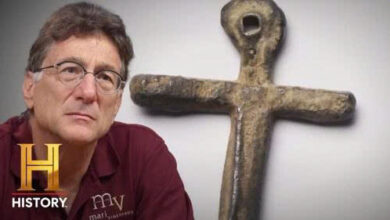
Italian researcher Emiliano Sacchetti is primarily carrying on the work of Zena Halpern, investigating the links between the Templar Knights and Oak Island. But intriguingly, he’s also retrieved a map of the Osimo cave that seems to feature a cavern shaped like the 14th-century lead cross found on Oak Island.
Don’t believe me? Check out the image below.

The Curse of Oak Island airs Tuesdays at 9/8c on History.